Translation memory leverage sheet
- Cost of the release across every locale
- 11,592.00
- Computed on this page from the inputs below
- New words per locale
- 9,600
- Computed on this page from the inputs below
- Fuzzy-matched words per locale
- 6,000
- Computed on this page from the inputs below
- Exact-matched words per locale
- 8,400
- Computed on this page from the inputs below
Every figure here comes from the figures you enter and the method stated beside it: your word count, your locales, your memory's match shares, your vendor's rates, your strings and the defects your locale pass found. Where a guide names a published figure it names the source and the date it was read. This site publishes no translation, no vendor's price and no ranking: what a word costs in a language is your vendor's quote, and the standards cited on each guide are the starting point, not the ruling.
Email me this result
We will send you these figures and a link back to them. One email, nothing else unless you tick the box.
The figures above start from a worked example (11,592.00). Change any input and the answer updates as you type, the way it will when the vendor's quote lands.
Download the Translation memory leverage sheet worked example (CSV)
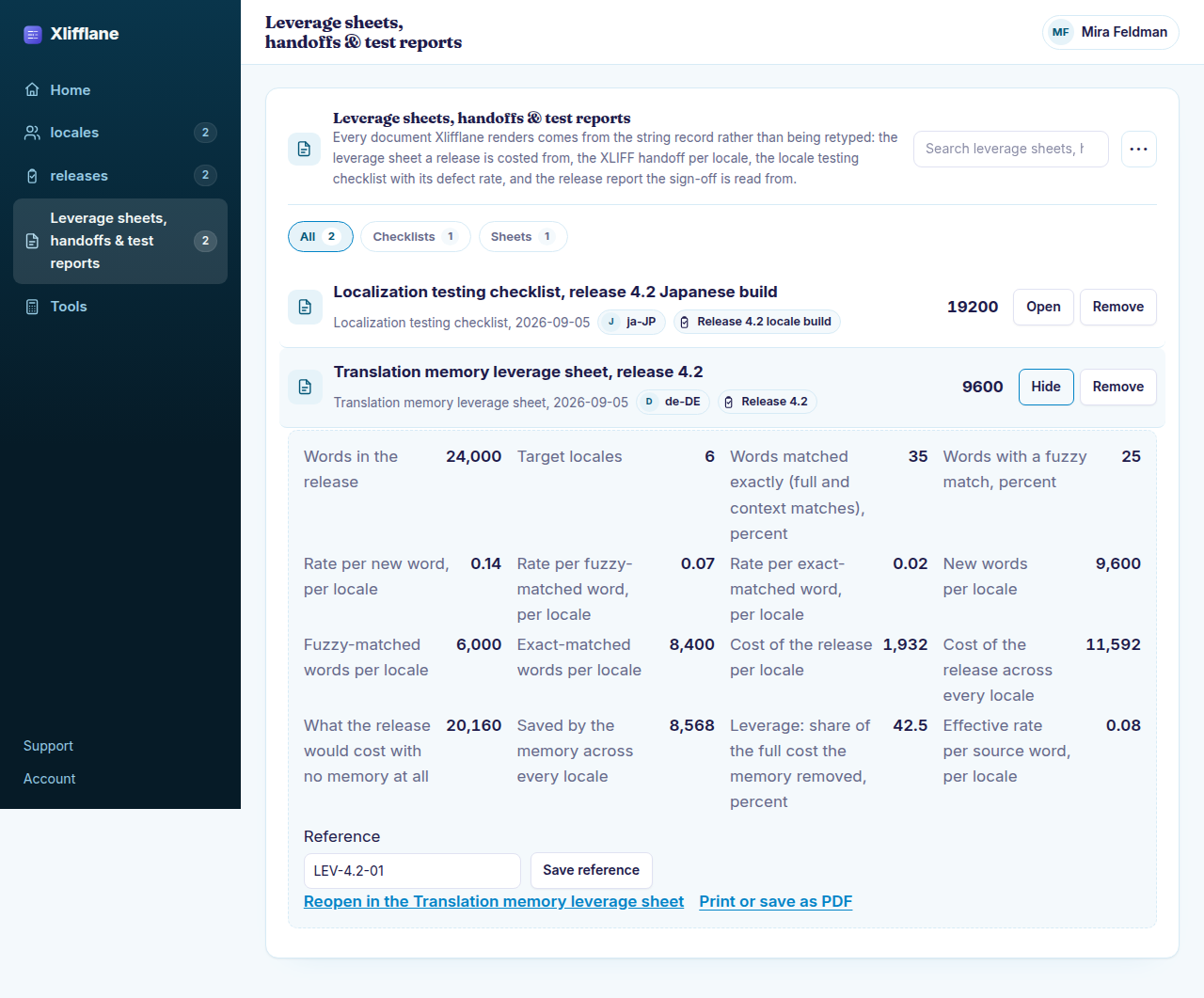
The translation memory leverage sheet costs a release from your own analysis rather than a published rate card: the source word count of the strings that changed, the locales the product ships in, the share of those words the memory matches exactly and the share it matches fuzzily, and the rate the vendor charges for a new word, a fuzzy match and an exact match. It returns the new, fuzzy and exact words per locale, the cost of the release per locale and across every locale, what the release would cost with no memory at all, the saving the memory delivered and that saving as a share of the full cost, which is the leverage, and the effective rate per source word. It is the sheet a localisation engineer builds in a spreadsheet every release, with the arithmetic written down so the budget review can argue with the inputs instead of the answer.
Why the sheet asks for match shares, not a total
A vendor's quote is a word count times a rate, and it hides the one thing the team controls: how much of the release the memory already holds. A release that is a third exact matches and a quarter fuzzy matches costs a fraction of one that is all new words, at the same headline rate, and the analysis report every translation tool produces gives those shares before anybody agrees a price. The sheet takes each share and its rate, so the effect of a rate negotiated on fuzzy matches, or of a memory grown by one more release, can be tried on the page before the purchase order is raised.
Leverage is a percentage until it is a budget
The saving the memory delivered is the difference between the release at the full rate and the release as the analysis splits it, and the share of the full cost that saving represents is the memory's leverage. On the worked example a release that is a third exact and a quarter fuzzy across six locales costs well under three quarters of what the same words would cost with no memory, and that gap is the argument for keeping the memory as a record rather than as a file the vendor holds. Xlifflane Pro keeps every translated segment against its key so the next release's analysis reads the team's own memory, not the vendor's.
The effective rate is the figure to compare vendors on
Dividing the release's cost per locale by its word count gives the effective rate per source word, which is the honest figure when two vendors quote different rates for new words and different discounts on matches. A vendor with a higher new-word rate and a better fuzzy discount can be cheaper on a release the memory holds well and dearer on a release that is mostly new strings, and the sheet shows which one this release is. The cost with no memory beside it is the ceiling the whole conversation sits under.
What a localisation engineer asks before running the Translation memory leverage sheet
Which figures do I need before using the translation memory leverage sheet?
The source word count of the release, the target locales, the analysis report's exact-match and fuzzy-match shares, and the rate the vendor charges for a new word, a fuzzy-matched word and an exact-matched word. The shares come from the translation tool's analysis against the memory; the rates come from the vendor's rate card.
What is translation memory, and why does it change the cost?
A translation memory is the store of every source segment the team has had translated, with its translation per locale. When a new release contains a segment the memory already holds, exactly or nearly, the tool offers the stored translation and the vendor charges a lower rate to review it than to translate it fresh. The sheet prices each share at its rate, which is where the saving comes from.
Does the sheet handle different rates per locale?
Run it once per locale, or per group of locales that share a rate card, because a Japanese new-word rate and a Spanish one are rarely the same. The locales input multiplies one locale's cost across the set, which is right when the rates are the same and a rough guide when they are not.
Xlifflane Pro
Keeping the string catalog the whole release reads from
Upgrading turns the worksheet into the record. The word count becomes a catalog with keys on it; every translation is recorded against its key and locale with a status; the handoff is generated from the record and the translator's file is read back against it; every release's leverage sheet and locale test results file themselves under the release. Export is always available, so the catalog and the memory are yours whether or not you stay.
- Download the leverage sheet or the checklist as a file to send to the team
- Your leverage sheets and test reports without our name on them
- Save a release's sheet and open it again next sprint
- Your product name and logo on every printed sheet and handoff
- Take every sheet, handoff and test report out at once
- Send a handoff or a locale test report to the translator or the team from inside the record
$135per month, whole team
Start Xlifflane Pro Free for 14 days. No card needed. PricingThe first 14 days are free and no card is asked for. Add a card during the trial and the first charge is on the day it ends; do not, and your workspace becomes read-only with nothing deleted. Xlifflane Pro is $135 per month for your whole team, billed monthly, and renews each month at that price until you cancel. The price and the renewal terms are shown again before checkout.
Where the method in this worksheet comes from
GALA, TMX 1.4b: the Translation Memory eXchange specification, the format a memory is exported in so the leverage belongs to the team rather than the vendor. Why the sheet treats the memory as the team's own asset: the memory can be exported in an open format and analysed by any tool, so the match shares are the team's figures rather than the vendor's.
OASIS, XLIFF Version 2.1: the interchange format the analysed segments are handed off in, with the match data carried alongside each segment. Why the shares are worked per release: the handoff carries each segment with its match state, so the exact and fuzzy counts the sheet asks for are read from the file that goes to the vendor.